
Chakra Balancing and Energy Healing at Peace of Mind Health, Hinckley

You do not need to speak Sanskrit to feel when your energy is off. Most people know the experience precisely — a heaviness that will not lift, a tightness in the chest that arrives with no obvious cause, a sense of being disconnected from yourself or from what matters, a draining of the vitality that used to feel natural. The mind searches for a reason. The body simply knows something is not flowing as it should.
This is the experience that chakra balancing addresses — not through analysis or explanation, but by working directly with the body’s energy system to clear what has become blocked, restore what has become depleted, and bring the whole system back into the natural coherence that underlies genuine wellbeing.
At Peace of Mind Health in Hinckley, chakra balancing is offered as a deeply therapeutic and restorative energy healing experience — intuitive, tailored, and held within Jeni’s extensive training across Reiki, crystal healing, sound therapy and the full spectrum of energy medicine.
What the Chakra System Is — and Why It Matters
The word chakra comes from the ancient Sanskrit, meaning wheel or vortex. In the Ayurvedic and yogic traditions of India — systems of understanding the human body and its health that predate modern medicine by thousands of years — the chakras are seven primary energy centres that run along the central axis of the body, from the base of the spine to the crown of the head. Each one is understood as a dynamic, spinning vortex of life force energy, or prana — both drawing energy in from the universal field and radiating it outward through the body, the mind and the emotional system.
What makes the chakra system so compelling to a modern understanding is the precision of the correspondence it describes between energy centres and physiology. Each of the seven chakras sits in anatomical relationship with a major nerve plexus — a junction point of the autonomic nervous system — and with a corresponding endocrine gland. Research published in peer-reviewed journals has identified that the locations of the chakras correspond closely with these nerve plexuses and with the body’s major hormonal control centres — the areas that regulate the stress response, the immune system, reproductive health, digestion, cardiac function and the brain itself.
This correspondence is not coincidence. It suggests that what ancient traditions mapped as energy centres, modern anatomy has independently identified as the body’s most critical regulatory hubs. When these hubs are functioning well — when energy flows freely through them — the physiological systems they govern tend to work in balance. When they are blocked, depleted or overactivated, the systems they govern often reflect that imbalance in measurable ways.
The Seven Chakras — and What Each Governs
The Root Chakra (Muladhara) — located at the base of the spine, corresponding with the sacral nerve plexus and the adrenal glands. It governs our sense of physical safety, grounding, stability and survival. When depleted or blocked, the experience is often one of chronic anxiety, fear, feeling unsafe in the world, financial worry, and physical symptoms including lower back pain, digestive issues and immune difficulties. When the adrenal glands — the body’s primary stress-response organs — are exhausted from chronic activation, root chakra work is often profoundly restorative.
The Sacral Chakra (Svadhisthana) — located in the lower abdomen, corresponding with the lumbar plexus and the reproductive glands. It governs creativity, pleasure, emotional fluency, and our capacity for intimacy and healthy relationship. Imbalance here often manifests as emotional numbness or volatility, reproductive difficulties, low libido, creative blocks and a sense of joylessness.
The Solar Plexus Chakra (Manipura) — located at the upper abdomen, corresponding with the solar plexus nerve complex and the pancreas. It governs personal power, self-worth, confidence and will. Imbalance often presents as low self-esteem, anxiety, difficulty making decisions, digestive complaints and a sense of powerlessness or inability to set boundaries.
The Heart Chakra (Anahata) — located at the centre of the chest, corresponding with the cardiac plexus and the thymus gland — the seat of the immune system. It governs love, compassion, forgiveness and connection — both with others and with ourselves. Grief, loss, chronic loneliness and emotional wounds around love very often register here as physical tightness, breathing difficulties or immune vulnerability. The heart chakra is also the bridge between the lower, more physical chakras and the upper, more spiritual ones — its balance is central to the health of the whole system.
The Throat Chakra (Vishuddha) — located at the throat, corresponding with the cervical plexus and the thyroid gland. It governs authentic expression, communication and the ability to speak our truth. Imbalance often manifests as thyroid difficulties, chronic throat tension, difficulty speaking up, fear of being heard and the physical and emotional symptoms of long-suppressed expression.
The Third Eye Chakra (Ajna) — located between the eyebrows, corresponding with the pineal gland. It governs intuition, insight, perception and inner wisdom. Imbalance often presents as mental fog, difficulty trusting instinct, overreliance on external validation, sleep difficulties linked to disrupted melatonin, and a sense of disconnection from inner knowing.
The Crown Chakra (Sahasrara) — located at the top of the head, corresponding with the pituitary gland — the master gland of the endocrine system, which regulates the entire hormonal cascade. It governs our connection to something greater than the individual self, our sense of meaning, purpose and spiritual belonging. Imbalance here often manifests as existential emptiness, a profound sense of disconnection, and the feeling of living without direction or deeper meaning.
When Chakras Become Imbalanced — and Why
Chakra imbalance is not a permanent or fixed state. It is a dynamic response to the conditions of a life. Stress, trauma, grief, chronic emotional suppression, physical illness, significant life transitions and the accumulated weight of long-term pressure all register in the energy system — and tend to do so in specific, recognisable patterns that correspond to the nature of the experience and the chakra most associated with it.
A chakra can be blocked — meaning its energy is restricted, collapsed or stagnant — or it can be overactivated, spinning too fast or drawing too much energy in response to perceived threat or unmet need. Both states create imbalance and both have physical, emotional and psychological correlates.
Because the chakras are interconnected — each one influencing those above and below it — imbalance in one centre tends to ripple through the whole system. This is why a thorough chakra balancing session works with the whole system rather than targeting a single centre in isolation.
What a Chakra Balancing Session Involves
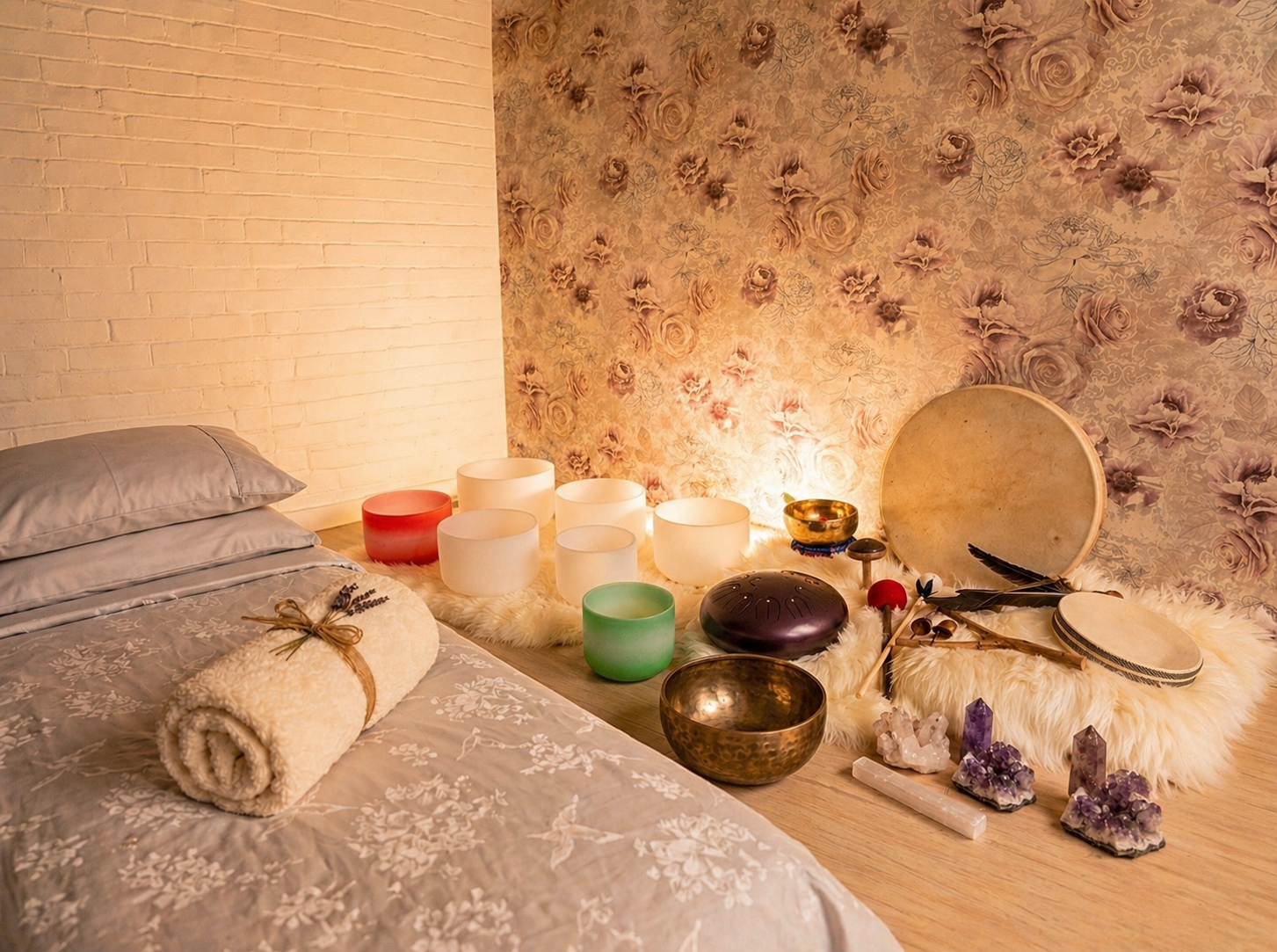
You arrive and are welcomed into the calm treatment space at Peace of Mind Health in Hinckley. After a brief conversation about what you are experiencing, you lie comfortably on the treatment couch — fully clothed, supported and warm.
Jeni works intuitively, sensing the state of each chakra through the body’s energy field and responding to what she finds. Using a combination of Reiki energy healing, crystal therapy, sound healing, intuitive energetic alignment and aura clearing, she works with each energy centre in turn — clearing what is blocked, restoring what is depleted, calming what is overactivated, and bringing the whole system back into natural coherence.
Crystals are chosen for their specific vibrational properties and placed on or near the body to support each chakra’s restoration. Sound instruments — singing bowls, tuning forks, chimes — may be used to introduce the specific frequencies that correspond to each centre. Intuitive guidance or messages may arise during the session and be shared with you afterwards if relevant.
Most clients experience deep relaxation, warmth, tingling sensations, and a felt sense of something releasing or settling. Many describe a quality of lightness and clarity that stays with them for days. Sessions are never identical — because the energy system is always in a different state — and each one is a unique, responsive experience.
What Chakra Balancing Can Help With
Because the chakra system governs the body’s regulatory centres — nervous system, endocrine system, immune function and more — restoring balance to it can have wide-reaching effects. Clients seek chakra balancing for support with:
- Chronic stress, anxiety and the sense of being energetically depleted
- Emotional heaviness, numbness or volatility
- Hormonal imbalance and endocrine-related concerns
- Immune challenges and recurring illness
- Digestive difficulties
- Sleep disruption and fatigue
- Thyroid and throat concerns
- Grief and the energetic weight of loss
- Chronic pain and physical tension held in specific areas of the body
- Creative blocks and loss of joy
- Low confidence, self-worth and difficulty with boundaries
- Difficulty with authentic communication or expression
- Intuitive disconnection and mental fog
- Spiritual disconnection or a loss of meaning and purpose
- Major life transitions and the energetic upheaval they bring
- Preparation for or integration after other therapeutic or healing work
Chakra Balancing Works Beautifully Alongside
At Peace of Mind Health, chakra balancing naturally complements and deepens the effects of other therapies. It combines particularly well with Reiki Energy Healing, Sound Healing, Clinical Reflexology, Somatic Therapy and Shamanic Healing. Many clients include chakra balancing as a regular part of their overall health and wellbeing maintenance — returning monthly or seasonally to keep the energy system clear and coherent.
Aftercare
Following a chakra balancing session, we recommend:
- Drinking plenty of water throughout the rest of the day to support energetic integration
- Resting where possible and being gentle with yourself
- Spending time in nature if that feels supportive
- Avoiding alcohol and caffeine for the remainder of the day
- Noticing and allowing any emotions, physical sensations or insights that arise
Some clients experience a brief period of heightened emotion, vivid dreams or physical sensations in the 24 to 48 hours following a session — signs that the energy system is integrating and rebalancing. This is entirely normal. If anything feels intense or you have questions, please do get in touch.
Ready to Restore Your Energy?
If you are ready to experience the clarity and ease that comes when your energy is flowing freely — when the heaviness lifts, the fog clears and you feel like yourself again — Jeni would love to welcome you.
Please get in touch for a confidential chat, or read what clients have to say here.
You can also explore:
- Treatment Prices
- Jeni’s Qualifications
- Reiki Energy Healing
- Sound Healing
- Theta Healing
- Kinesiology
- Shamanic Healing and Soul Retrieval
- Read the Blog
- Follow on Facebook
Website: www.peaceofmindhealth.co.uk
Email: [email protected]
Tel: 07531 191 688
“Be free… Be happy… Be healthy.”